

Every missed call is a missed opportunity. For small businesses that depend on inbound leads — service companies, medical practices, law firms, dealerships, salons, home services — a ringing phone that goes unanswered is revenue walking out the door.
Missed call text back software solves the simplest version of this problem: when you can't answer the phone, the system automatically sends the caller a text message within seconds. That text acknowledges the call, keeps the conversation alive, and gives the prospect a reason to stay engaged instead of calling your competitor.
It sounds basic. It is basic. But for businesses that miss even a handful of calls per day, it is one of the highest-ROI tools available.
What is missed call text back?
Missed call text back is an automated workflow that detects when an inbound call goes unanswered and immediately sends a pre-written SMS to the caller. The message typically:
- acknowledges the missed call
- apologizes for not being available
- invites the caller to text back or provides next steps
- optionally includes a link to book an appointment or leave details
The goal is to convert a dead-end missed call into an active text conversation or a booked appointment — before the caller moves on.
Why missed calls matter more than most businesses realize
The data on missed calls is brutal:
- 80% of callers will not leave a voicemail when they reach one
- 85% of people whose calls go unanswered will not call back
- The average small business misses 40-60% of inbound calls during peak hours
- Prospects who don't get a response within 5 minutes are 21x less likely to convert
For a business running paid advertising, every missed call has a real cost attached to it. You paid for that lead. If nobody answers and there is no fallback, the money is gone.
Missed call text back software is the minimum viable safety net. It does not replace answering the phone, but it catches the calls that slip through and keeps them alive.
How missed call text back software works
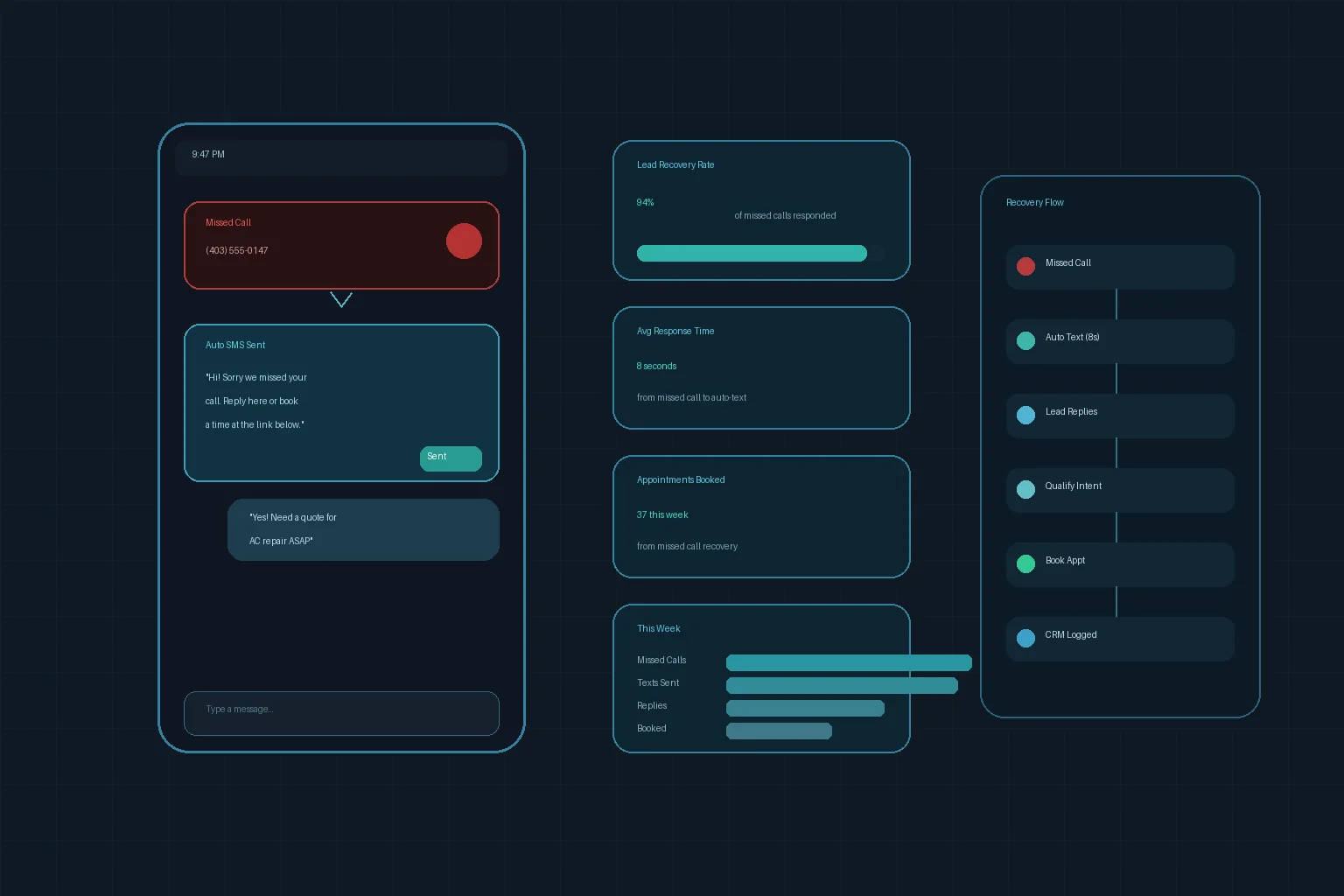
The typical flow is straightforward:
- Inbound call comes in — the phone rings at your business number
- Call goes unanswered — busy, after hours, in a meeting, on another call
- System detects the miss — usually within 5-10 seconds of the call ending
- Automatic SMS is sent — a pre-configured text goes to the caller's number
- Conversation continues via text — the caller can reply, and your team picks up the thread
Most systems let you customize:
- the text message content
- the delay before sending (immediate vs. 30 seconds vs. 1 minute)
- business hours rules (different messages for daytime vs. after hours)
- which phone numbers or lines trigger the auto-text
Some platforms go further and connect the text conversation to a CRM, trigger follow-up sequences, or route the lead into an appointment booking flow.
What to look for in missed call text back software
Not all solutions are equal. Here is what separates a useful tool from a basic auto-responder.
Instant delivery
Speed matters. The text should go out within seconds of the missed call, not minutes. If the caller has already dialed a competitor by the time your text arrives, it is too late.
Customizable messages
A generic "Sorry we missed your call" is better than nothing. But a message that references your business name, offers a booking link, or asks a qualifying question is significantly better.
Good example:
"Hi, this is [Business Name]. Sorry we missed your call! How can we help? You can reply here or book a time at [link]."
Bad example:
"Missed call. We'll call you back."
Business hours awareness
Your after-hours auto-text should be different from your daytime auto-text. During business hours, the message might say "We'll call you right back." After hours, it should set expectations: "We're closed right now but will follow up first thing tomorrow — or reply here and we'll get back to you."
Two-way texting
The auto-text is the opener. What matters next is whether your team can actually continue the conversation via SMS. One-way auto-texts with no reply path are a dead end. Two-way texting keeps the lead warm and gives your team a real channel to work.
CRM integration
For businesses running a CRM — HubSpot, Salesforce, HighLevel, or anything else — the missed call and the text conversation should be logged automatically. If your team has to manually copy information from a text thread into the CRM, it will not happen consistently.
Lead routing and notifications
When a missed call triggers an auto-text and the caller replies, someone on your team needs to know immediately. The system should notify the right person — not just log it quietly where nobody sees it until the next day.
Appointment booking
The highest-converting missed call text back flows include a direct link to book an appointment. Instead of asking the caller to wait for a callback, give them a way to self-schedule. That converts the missed call into a booked meeting with zero manual effort.
Who benefits most from missed call text back?
Missed call text back software is most valuable for businesses where:
- inbound calls are the primary lead source
- the team is small and cannot always answer every call
- call volume is inconsistent (peaks during lunch, evenings, weekends)
- the business runs paid advertising that drives phone calls
- response time directly impacts close rates
Home services
Plumbers, electricians, HVAC techs, roofers, and landscapers are often on job sites and physically cannot answer the phone. An auto-text keeps the lead engaged until the team can follow up.
Healthcare and dental
Medical offices, dental practices, and clinics get high call volumes with limited front desk staff. Missed call text back catches overflow calls and after-hours inquiries without adding headcount.
Legal
Law firms depend on fast response to inbound leads. A potential client calling about a case will not wait around. An immediate text acknowledges the inquiry and buys time for a proper callback.
Automotive and dealerships
Dealerships and service departments miss calls constantly during peak hours. A text back with a booking link or a "How can we help?" opener captures intent that would otherwise evaporate.
Salons and spas
Appointment-based businesses lose bookings when calls go unanswered. A missed call text with a scheduling link converts the missed call directly into a booked slot.
Real estate
Agents are in showings, meetings, and on the road. Missed call text back is table stakes for making sure buyer and seller leads get an immediate response.
Missed call text back vs. a full after-hours system
Missed call text back is a single-action tool. It sends a text when you miss a call. That is valuable, but it is only one piece of the lead recovery puzzle.
A more complete system handles:
- Call answering — not just texting after the miss, but answering the call in the first place
- Lead qualification — determining what the caller needs and how urgent it is
- Appointment booking — scheduling directly from the interaction
- CRM logging — creating a record without manual data entry
- Follow-up sequences — multi-step outreach if the lead does not respond to the first text
- Escalation rules — routing urgent calls to on-call staff in real time
Missed call text back is a great starting point. But if your business is losing significant revenue from unanswered calls, a text-only solution may not be enough.
For businesses that need the full after-hours coverage stack, see our guide on after-hours answering services for small business.
How missed call text back fits into a lead recovery workflow
The best way to think about missed call text back is as the first layer in a lead recovery system:
Layer 1: Missed call text back Catches the miss instantly. Keeps the lead warm. Opens a text channel.
Layer 2: Two-way conversation Your team (or an AI assistant) continues the conversation via SMS. Qualifies the lead. Answers questions.
Layer 3: Appointment booking Converts the text conversation into a booked meeting, consultation, or service call.
Layer 4: CRM and follow-up Logs the interaction. Triggers follow-up if the lead goes cold. Tracks the full lifecycle.
Layer 5: After-hours operations Extends coverage beyond business hours with AI-powered call handling, lead capture, and routing.
Each layer adds more recovery capability. Missed call text back is Layer 1 — essential, but most effective when it feeds into a broader system.
What it costs
Missed call text back software pricing varies widely:
- Standalone tools — $20-$50/month for basic auto-text on one line
- CRM-integrated platforms — $50-$300/month depending on features and volume (HighLevel, Podium, Birdeye, etc.)
- Full AI workflow platforms — varies based on scope, but covers text back plus call handling, qualification, booking, and CRM logging
For most small businesses, the cost is trivial compared to the value of even one recovered lead per month. If your average deal value is $500 or more, missed call text back pays for itself almost immediately.
The bottom line
Missed call text back software is the lowest-effort, highest-ROI tool a small business can deploy for lead recovery. It does not require new staff, complex integrations, or a change in how your team works. It just makes sure that when you miss a call, the caller gets an immediate response instead of silence.
For businesses that want to go further — qualifying leads, booking appointments, logging everything to the CRM, and covering after-hours calls with AI — missed call text back is the foundation that everything else builds on.
If your business is ready to stop losing leads to missed calls, book a demo and we'll show you how Blackbox recovers revenue that would otherwise walk out the door.